

Students interested in medical diagnostics often come across two options: DLT and B.Sc. LT. Both courses introduce learners to laboratory testing, sample handling and diagnostic procedures, but they may differ in academic depth, duration, eligibility and long-term learning opportunities.
Choosing between a Diploma in Laboratory Technology and a Bachelor of Science in Laboratory Technology should depend on your academic background, career plans and preferred learning format. Students in Pune should compare the complete programme details instead of selecting a course solely by its duration.
KP Paramedical Institute guides students exploring laboratory technology courses in Pune. Understanding the practical differences between diploma-level and degree-level education can help applicants select a suitable path.
What Is DLT?
DLT commonly refers to a Diploma in Laboratory Technology or a similarly structured diploma-level programme. Its curriculum generally focuses on the essential knowledge and practical skills needed in a medical laboratory.
Students may learn about:
- Sample collection and preservation
- Basic pathology procedures
- Haematology
- Clinical biochemistry
- Microbiology
- Laboratory equipment
- Infection control
- Biomedical waste management
- Report documentation
A diploma course may appeal to students looking for focused technical education and an earlier introduction to laboratory work.
What Is B.Sc. LT?
B.Sc. LT is a degree-level programme that generally examines laboratory science in greater academic depth. In addition to routine testing procedures, students may study advanced concepts, research principles, quality assurance and laboratory management.
The curriculum can include:
- Advanced clinical pathology
- Medical microbiology
- Immunology
- Histopathology
- Transfusion science
- Molecular diagnostic concepts
- Research methodology
- Laboratory quality management
Because programme structures differ, applicants should verify the current syllabus, duration and recognition before admission.
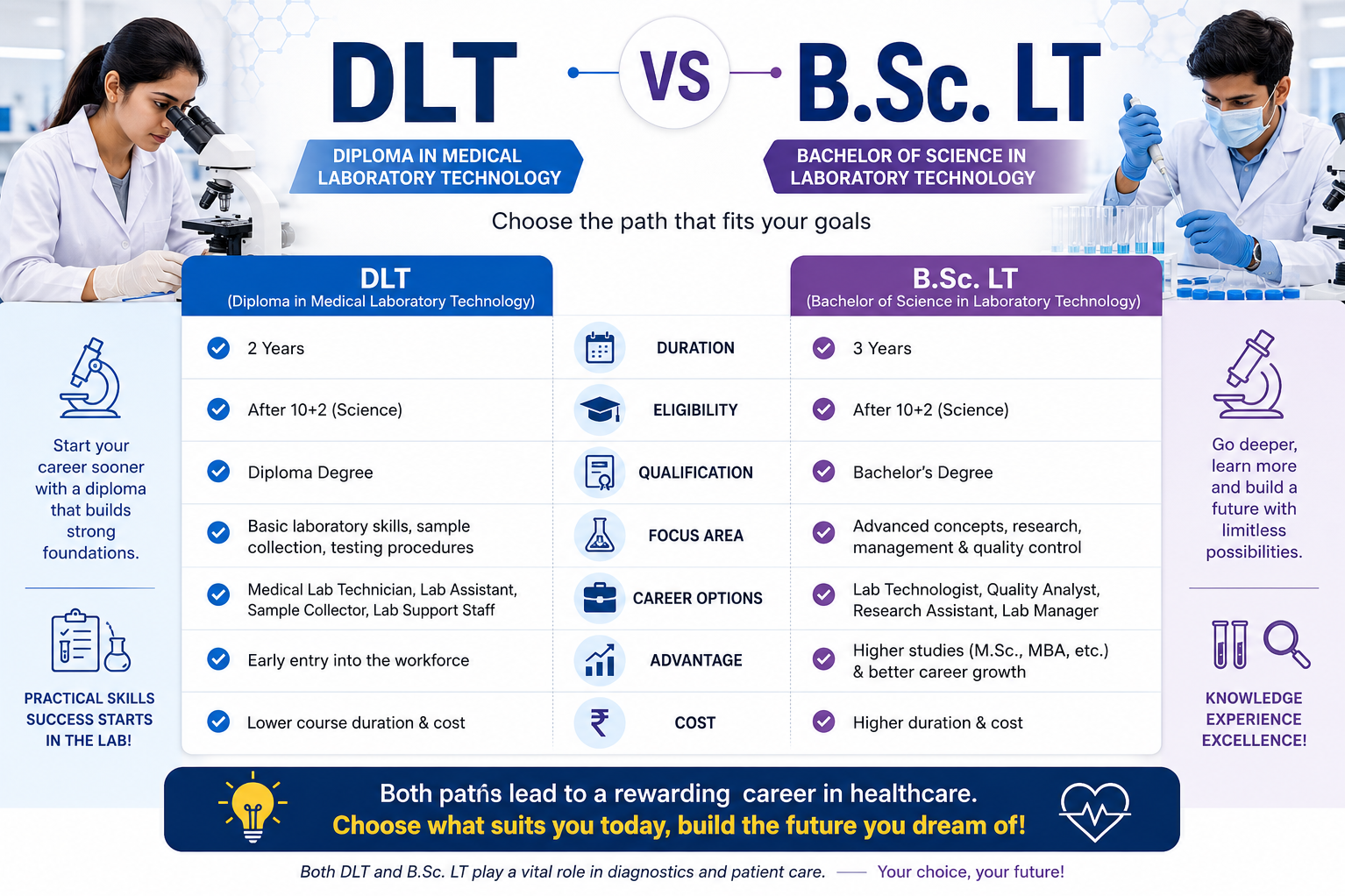
Comparing the Two Options
Several factors can help students decide between DLT and B.Sc. LT.
Academic depth
DLT usually concentrates on foundational technical competencies. B.Sc. LT generally offers broader scientific study and may include advanced laboratory subjects.
Course duration
A diploma is commonly shorter than a bachelor’s degree. Exact duration can vary according to the institute, awarding body and programme format.
Entry requirements
Eligibility may depend on the applicant’s educational qualification and subjects studied. Students should confirm whether a science background is required for their chosen programme.
Practical training
Both options should include practical learning. The quality of laboratory exposure, supervision and clinical training matters more than the course title alone.
Further education
A bachelor’s qualification may provide access to a wider range of postgraduate study options. Diploma holders may also continue their education, subject to institutional admission rules.
Career entry
Both qualifications may support applications for suitable entry-level laboratory roles, but employers can specify different educational and experience requirements.
Questions to Ask Before Choosing
Before taking admission in Pune, ask the institute:
- Who awards or recognises the qualification?
- What practical equipment will students use?
- Does the programme include clinical exposure?
- How are technical skills assessed?
- What are the attendance requirements?
- Is internship assistance available?
- Which further-study options may be available?
Making the Right Decision
DLT may suit students who want concentrated technical training, while B.Sc. LT may be more appropriate for those seeking comprehensive degree-level education. Neither option should be selected without reviewing its recognition, syllabus and practical component.
Pune offers access to hospitals, diagnostic centres and pathology laboratories across Maharashtra’s growing healthcare sector. Students who choose a credible programme and take practical training seriously can build a strong foundation for laboratory-based careers.